How to Read a Men's Supplement Label: A Buyer's Checklist
Written by the Horsewood Formula editorial desk
Last updated · Who reviewed this page · How we write and review
Read a men's supplement label from the top: serving size first, then each amount, the extract ratio, the elemental mineral weight and the plant part. Compare extract with extract against study doses, check the other ingredients and treat drug-like claims as red flags. Horsewood prints every amount, but the amounts are small.
Why read the Supplement Facts panel before the ad?
The Supplement Facts panel is the one part of a bottle that must list what is inside. Ads, badges and graphics can leave things out, and FDA does not approve supplements before they are sold (FDA, 2022).
That leaves the checking to you. This guide gives you a method for any men's supplement, then runs it on the Horsewood label.
- The panel lists amounts. The ad lists promises.
- When the two disagree, follow the panel.
- A missing fact is a question for the seller, not a guess.
What does serving size mean on the Horsewood label?
Serving size tells you how many capsules count as one dose. Every amount on the panel is per serving, so you must read it first.
The Horsewood panel says two capsules per serving and 30 servings per container. The sales page and a paid press release say one capsule a day. The label wins, and the math agrees: 60 capsules at two a day is 30 days, and six bottles cover 180 days.
Extract or powder? Reading the Horsewood ratios
An extract ratio tells you how concentrated an extract is. A 100:1 ratio means about 100 parts of raw plant went into each part of extract.
The ratio does not change what you swallow. On Horsewood, the capsule holds 10 mg of tongkat ali extract; the label's “about 1,000 mg” describes the raw root behind it. Trials of tongkat ali used 100 to 600 mg of extract a day (Leisegang et al., 2022), so compare extract with extract.
| Label line | In the serving | Label equivalent | Compare with |
|---|---|---|---|
| Tongkat ali | 10 mg of 100:1 extract | About 1,000 mg dry powder | 100-600 mg of extract in trials |
| Horny goat weed | 8 mg of 10:1 extract | About 80 mg dry powder | 250-500 mg in products on sale |
Horny goat weed has no clinical dose to compare with. Commercial products run 250 to 500 mg, usually standardized to icariin (Drugs.com, 2026). The Horsewood label gives no icariin figure.
What is elemental weight? The Horsewood boron line
Elemental weight is the weight of the mineral alone. A mineral is often bound to a carrier, such as an amino acid, and the carrier adds weight.
The Horsewood label lists 20 mg of boron amino acid chelate. That is the whole compound, so the boron inside is lower, and the label does not say how much.
NIH says labels should list elemental boron and sets the adult upper limit at 20 mg of elemental boron a day (NIH ODS, 2022). The Horsewood amount cannot reach that limit, since the compound itself weighs 20 mg. It also cannot be matched to a study dose without the elemental figure.
Which plant part is on the Horsewood label, and does it matter?
The plant part matters because roots, leaves and berries hold different compounds. A study of one part does not cover another.
The Horsewood label names the part for four herbs. Nettle is the clearest case: prostate research used nettle root, about 429 mg a day in one trial, while the label lists leaf (NIDDK LiverTox, 2023).
| Herb | Part on the Horsewood label | What to check |
|---|---|---|
| Saw palmetto | Berry extract | Research also used the berry, at far higher doses |
| Wild yam | Root extract | The body does not turn it into hormones |
| Sarsaparilla | Root extract | Not enough evidence for any use |
| Nettle | Leaf extract | Prostate studies used root, not leaf |
Does Horsewood use a proprietary blend?
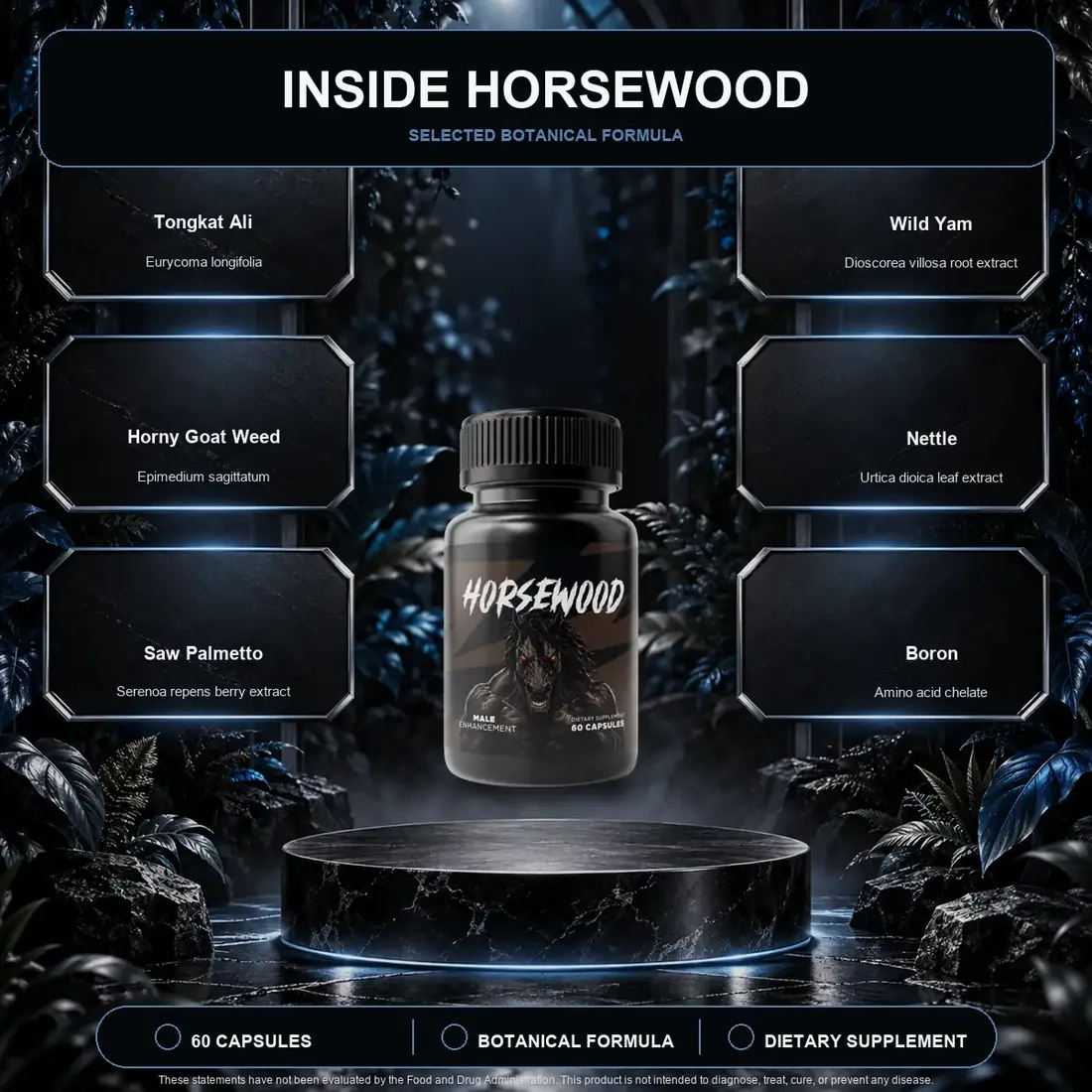
No. Horsewood prints a separate amount for each of its seven ingredients, adding up to 118 mg. That is a real strength of this label.
A proprietary blend lists several ingredients under one total weight and hides each share. You cannot compare a hidden amount with any study, so a blend is the first thing to look for.
What are the other ingredients in Horsewood?
Other ingredients are everything that is not an active ingredient. On Horsewood they are microcrystalline cellulose, gelatin and magnesium stearate.
Microcrystalline cellulose is a plant-based filler. Magnesium stearate helps powder flow in the capsule machine. Gelatin forms the shell.
Gelatin comes from animals, so the capsule is not vegetarian, even though a pack badge says so. Its source is not stated, which matters for halal and kosher diets.
How to read claims and the FDA line on Horsewood
A supplement may say it supports a normal body function. It may not say it treats, cures or prevents a disease, and its claims are not pre-approved by FDA (FDA, 2024).
The Horsewood sales page uses support wording, such as “Natural support for libido & desire.” It also uses lines like “Last longer, go harder, finish strong,” which no study of the formula backs. The FTC expects health claims to rest on human trials that match the product's dose (FTC, 2022).
“Supports libido” with the FDA disclaimer printed.
“Treats ED” or “works like a prescription pill.”
“FDA registered facility” describes a plant, and FDA issues no certificates (FDA, 2024).
How to compare a label amount with research
Set each label amount beside the dose a human study used, in the same form. If the label is far lower, the study's results do not carry over.
These five steps work on any bottle.
- 1
Find the serving
Read the serving size at the top of the panel and count how many servings the bottle holds.
- 2
Copy each amount
Write down every milligram as printed, and note whether it is an extract, a powder or a mineral compound.
- 3
Match the form
Look up the dose a human study used in the same form: extract against extract, elemental mineral against elemental.
- 4
Check the plant part
Confirm the study used the same part of the plant as the label, such as root or leaf.
- 5
Divide and decide
Divide the study dose by the label amount. A large gap means the study cannot predict a result.
Run on Horsewood, saw palmetto shows the method well. The label gives 20 mg; a large trial started at 320 mg a day, sixteen times more (Andriole et al., 2013). The ingredients page does this for every line.
The men's supplement label checklist
Run these ten checks on any men's supplement before you order. Tick a box only when the label or the seller confirms it.
Before you buy, check: 0 of 10 checked
Quality seals help with only part of this. NIH notes that seals check label accuracy, not safety or results (NIH ODS, 2023).
Horsewood scored against the label checklist
Here is the checklist run on Horsewood, from the label and the seller's terms only. It passes on printed amounts and claim format, and falls short on doses and lab proof.
A shortfall does not make the capsule unsafe. It means research cannot predict a result from it.
| Check | What Horsewood shows | Result |
|---|---|---|
| Serving matches ads | Label 2 capsules; ads say 1 | Fail |
| Every amount printed | Seven lines, 118 mg in total | Pass |
| Extracts compared fairly | 10 mg tongkat ali extract vs 100-600 mg in trials | Fail |
| Elemental mineral | Boron chelate weight only | Not published |
| Plant part matches research | Nettle leaf; studies used root | Fail |
| Other ingredients | Gelatin shell, not vegetarian | Check your diet |
| Claim format | Support wording plus the FDA line | Pass |
| Company and seal | Distributed for Horsewood, Largo, FL; seal warning printed | Pass |
| Lab report | Lot HOR-26/HO-1466 and CoA HOR-1466-26-HO are draft labels | Not published |
Each line of the panel is explained on the supplement facts page. If you have a symptom, read the men’s sexual health guide first.
Reading a supplement label: common questions
Common search questions, answered from the label and the sources cited on this page.
How do you read a Supplement Facts label?
Start at the top with the serving size, then read each ingredient line and its amount. Finish with the other ingredients, the warnings and the company details at the bottom.
What does serving size mean on supplements?
It is the amount the label counts as one dose. On Horsewood it is two capsules, so a 60-capsule bottle gives 30 servings.
What is the difference between extract and powder?
A powder is dried, ground plant. An extract is a concentrate made from that plant, so a small weight of extract can stand for a larger weight of raw plant.
What does an extract ratio like 100:1 mean?
It means about 100 parts of raw plant went into 1 part of extract. On Horsewood, 10 mg of 100:1 tongkat ali is described as equal to about 1,000 mg of dry root.
What is elemental weight on a mineral label?
It is the weight of the mineral alone, without the molecule bound to it. NIH says boron labels should list elemental boron (NIH ODS, 2022).
What is a proprietary blend?
It is a group of ingredients listed under one total weight, with single amounts hidden. You cannot match a hidden amount to a study dose.
What does the FDA disclaimer on supplements mean?
It means FDA has not reviewed the label's claims. Structure/function claims must carry that disclaimer and are not pre-approved (FDA, 2024).
What are “other ingredients” on a label?
They are the parts that are not active ingredients, such as fillers, flow agents and the capsule shell. They matter for diet rules and allergies.
Which plant part should be listed on a label?
The part that matches the research. Nettle studies for the prostate used root, for example, so a leaf extract cannot borrow those results.
What is a structure/function claim?
It is a statement that a product supports a normal body function, such as libido. It may not claim to treat or cure a disease.